Tom Graham

Tom Graham›Patents

Patents

Three United States patents on photoreal synthetic media, filed by Metaphysic between December 2022 and October 2023 and granted 2025–2026. Inventors on each: Tom Graham, Chris Ume, Jo Plaete and Martin Adams. Applicant: Metaphysic Limited.

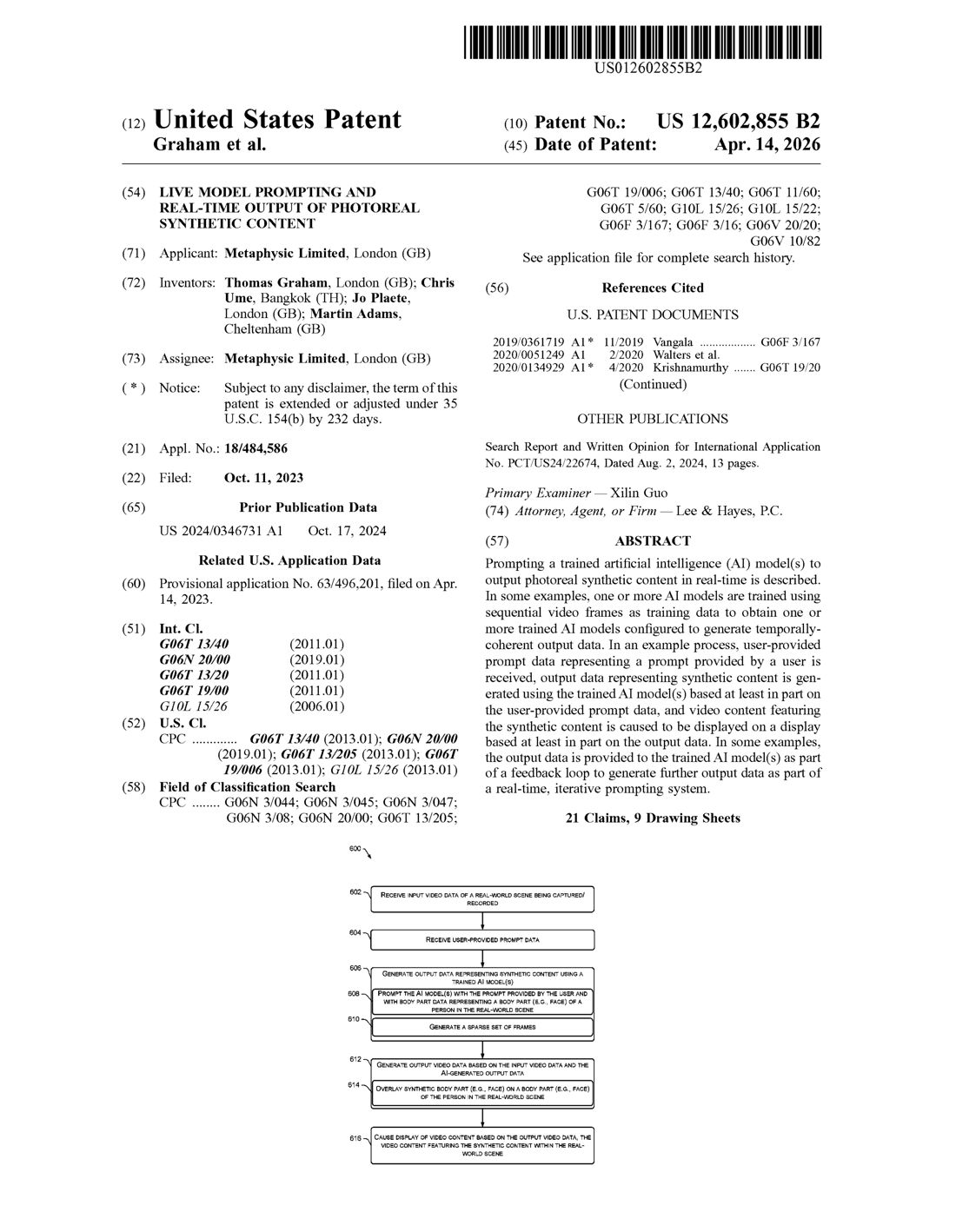
First page of US patent 12,602,855US 12,602,855 · Apr 2026

Live model prompting and real-time output of photoreal synthetic content

What it covers

The real-time system: a model trained on sequential frames so its output holds together over time, driven by a live prompt, with its own output fed back in. This is the patent behind the live performances, from the AGT stage to Eminem at the VMAs.

Abstract

Prompting a trained artificial intelligence (AI) model(s) to output photoreal synthetic content in real-time is described. In some examples, one or more AI models are trained using sequential video frames as training data to obtain one or more trained AI models configured to generate temporally-coherent output data. In an example process, user-provided prompt data representing a prompt provided by a user is received, output data representing synthetic content is generated using the trained AI model(s) based at least in part on the user-provided prompt data, and video content featuring the synthetic content is caused to be displayed on a display based at least in part on the output data. In some examples, the output data is provided to the trained AI model(s) as part of a feedback loop to generate further output data as part of a real-time, iterative prompting system.

Inventors and dates

Inventors: Tom Graham, Chris Ume, Jo Plaete and Martin Adams
Applicant: Metaphysic Limited, London
Filed 2023-10-11 · Granted 2026-04-14
Download the patent (PDF) · Google Patents
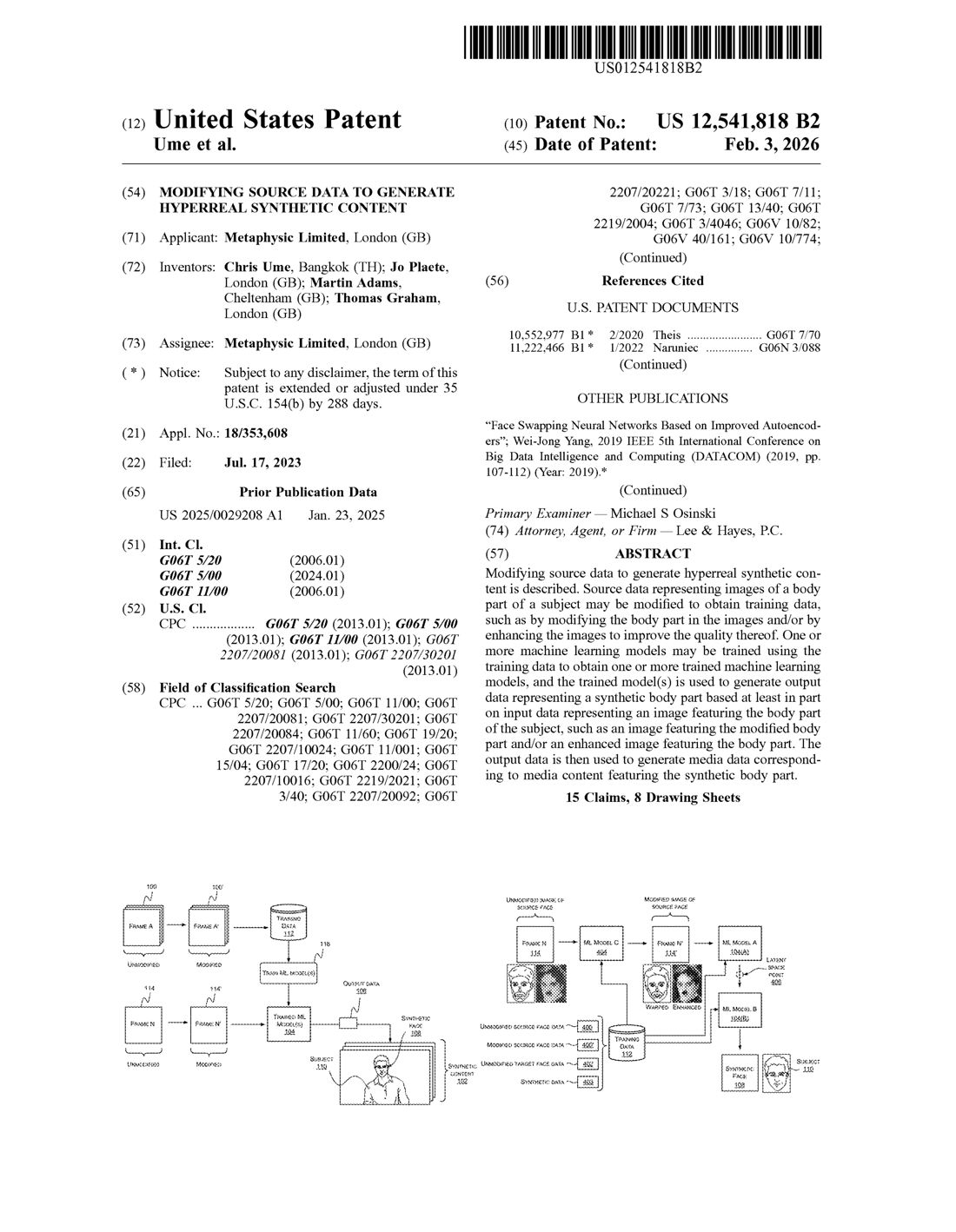
First page of US patent 12,541,818US 12,541,818 · Feb 2026

Modifying source data to generate hyperreal synthetic content

What it covers

The training-data patent: altering or enhancing the source images of a performer before training, so the model can age, de-age or restore a face. This is the method under the de-ageing in Here and the restoration of Richard Carter in Furiosa.

Abstract

Modifying source data to generate hyperreal synthetic content is described. Source data representing images of a body part of a subject may be modified to obtain training data, such as by modifying the body part in the images and/or by enhancing the images to improve the quality thereof. One or more machine learning models may be trained using the training data to obtain one or more trained machine learning models, and the trained model(s) is used to generate output data representing a synthetic body part based at least in part on input data representing an image featuring the body part of the subject, such as an image featuring the modified body part and/or an enhanced image featuring the body part. The output data is then used to generate media data corresponding to media content featuring the synthetic body part.

Inventors and dates

Inventors: Tom Graham, Chris Ume, Jo Plaete and Martin Adams
Applicant: Metaphysic Limited, London
Filed 2023-07-17 · Granted 2026-02-03
Download the patent (PDF) · Google Patents

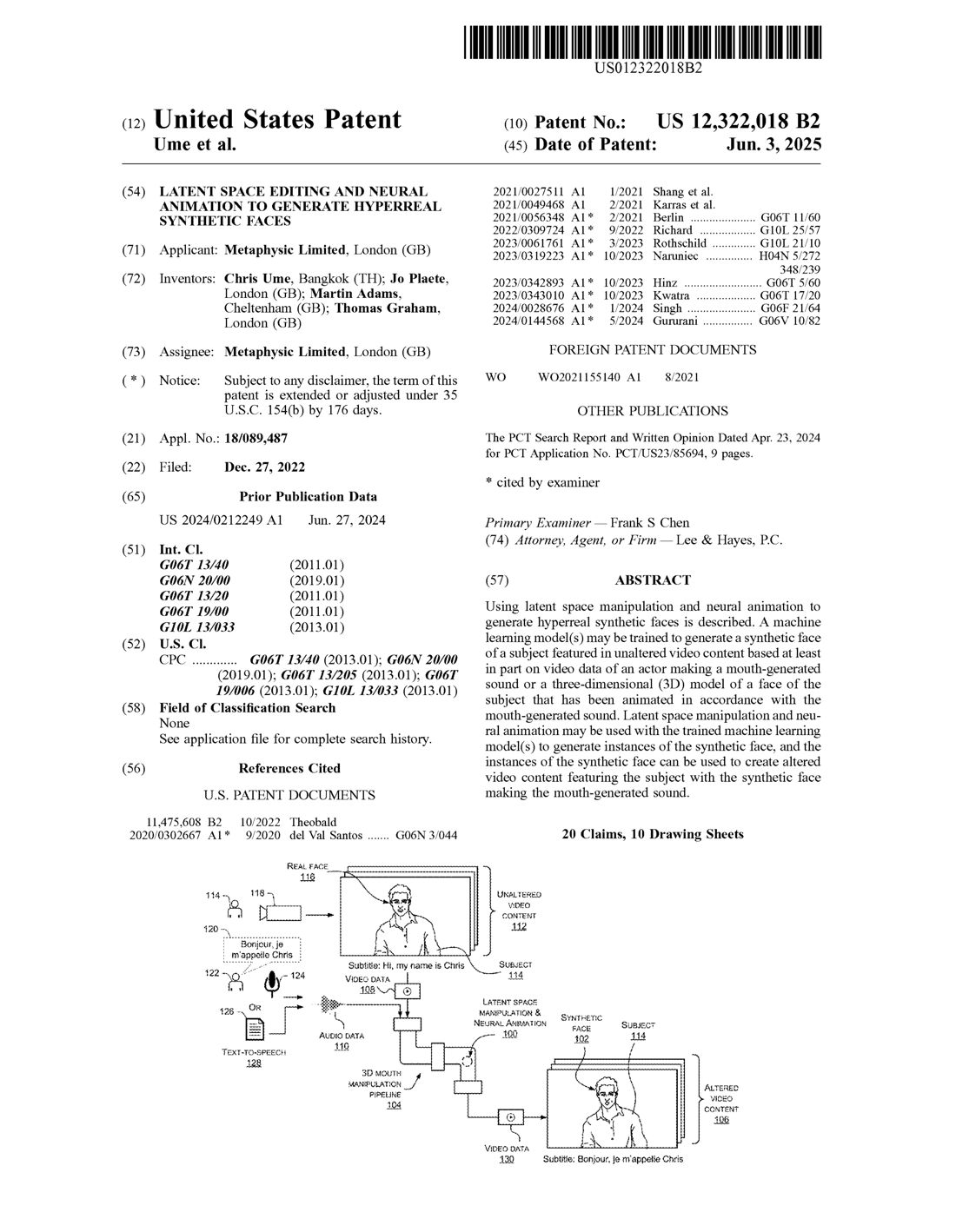
First page of US patent 12,322,018US 12,322,018 · Jun 2025

Latent space editing and neural animation to generate hyperreal synthetic faces

What it covers

The dialogue patent: editing a face in the model's latent space and animating it to new speech, so a subject can be shown saying something in another language, in their own face and voice. This is what carried Cai Guo-Qiang's Mandarin into English on the TED stage.

Abstract

Using latent space manipulation and neural animation to generate hyperreal synthetic faces is described. A machine learning model(s) may be trained to generate a synthetic face of a subject featured in unaltered video content based at least in part on video data of an actor making a mouth-generated sound or a three-dimensional (3D) model of a face of the subject that has been animated in accordance with the mouth-generated sound. Latent space manipulation and neural animation may be used with the trained machine learning model(s) to generate instances of the synthetic face, and the instances of the synthetic face can be used to create altered video content featuring the subject with the synthetic face making the mouth-generated sound.

Inventors and dates

Inventors: Tom Graham, Chris Ume, Jo Plaete and Martin Adams
Applicant: Metaphysic Limited, London
Filed 2022-12-27 · Granted 2025-06-03
Download the patent (PDF) · Google Patents